
Renal physiology: regulation of sodium and potassium excretion
Sodium
regulation
Function: NaCl is the
main determinant of ECF osmolality and volume.
Sodium
regulation
·
Low-pressure receptors in the
pulmonary vasculature and cardiac atria, and high-pressure baroreceptors in the
aortic arch and carotid sinus, recognize changes in the circulating volume.
·
Decreased blood volume causes
increase sympathetic activity and ADH secretion, causing decrease in NaCl
excretion.
·
Increased blood volume causes
increase sympathetic activity and decrease ADH secretion causing increase in NaCl
excretion.
Renin-Angiotensin-Aldosterone
system
Renin is an
enzyme made and stored in the juxta-glomerular cells found in the walls of the
afferent arteriole.
Factors
increasing renin secretion:
·
Reduced perfusion of afferent
arteriole
·
Sympathetic nerve activity
·
Reduced Na+ delivery to the
macula densa
Renin converts
angiotensinogen to Angiotensin I.
Angiotensin
I is converted to angiotensin II in the lungs by angiotensin-converting enzyme
(ACE).
Angiotensin
II result in the retention of salt and water by:
·
Stimulates aldosterone secretion
(resulting in NaCl reabsorption)
·
Vasoconstriction of arterioles
·
Stimulates ADH secretion and
thirst
·
Enhances NaCl reabsorbtion by the
proximal tubule
Potassium
regulation
Function: K+
is critical for many cell functions.
Potassium
regulation
·
A large concentration gradient
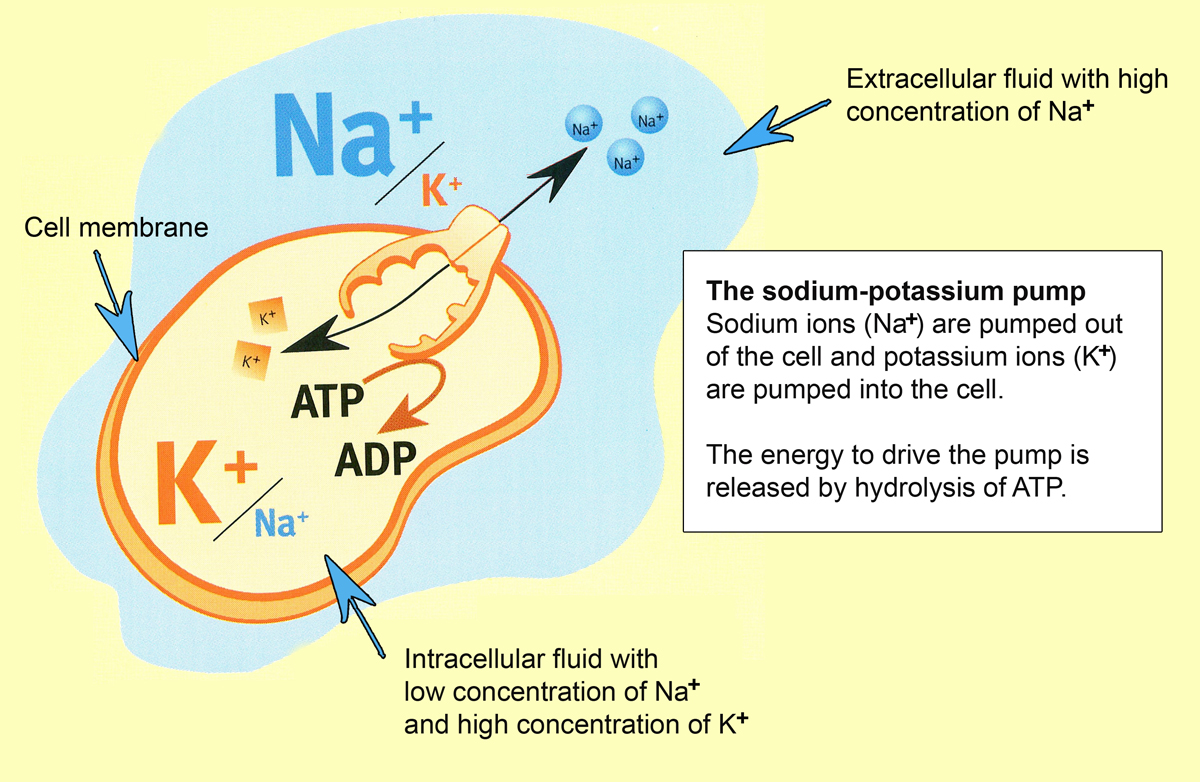
across cell membranes is maintained by Na+-K+-ATPase
pump. Insulin and adrenaline also promotes cellular uptake of K+.
·
The kidney excretes up to 95% of
K+ ingested in the diet.
·
The DCT and CD are able to both
reabsorb and secrete K+.
Factors increasing
K+ secretion:
·
Increased dietary K+
(driven by the electrochemical gradient)
·
Aldosterone
·
Increased rate of flow of tubular
fluid
·
Metabolic alkalosis (acidosis
exerts the opposite effect)
Osmolality =
moles per kg water. Osmolarity = moles per litre of solution.


